
Email
info@artemisdx.com
Phone
(+01) 760 978 9353

Artemis Dx
A Lateral Flow Test, also called LFT, immunochemical test strip, immunochromatigraphic test, dipstick test, to detail a few names, is a simple diagnostic test used to detect the presence or estimate the concentration of a specific substance in a liquid sample. This can be a protein, virus, bacteria, drug, etc. which can be detected from a nasal fluid, saliva, blood, serum, plasma, feces or urine sample. These tests are rapid, near-patient tests that usually can yield a result in around 10-15 minutes without requiring complex laboratory equipment. Common examples include pregnancy tests, COVID-19 rapid antigen tests, and rapid tests for certain infectious diseases (Flu, RSV, Lymes, etc.) They can be developed in 2 formats: a competitive Inhibition binding assay (as shown in the diagram above) or a non-competitive Sandwich LF assay (as shown in the diagram above).
Lateral flow tests usually use antigen–antibody interactions to detect a target substance. The liquid sample moves along a porous membrane by
capillary action, carrying the sample and detection reagents that will produce a result when the target is present.
A typical lateral flow assay consists of five main components assembled on a mylar backing card.
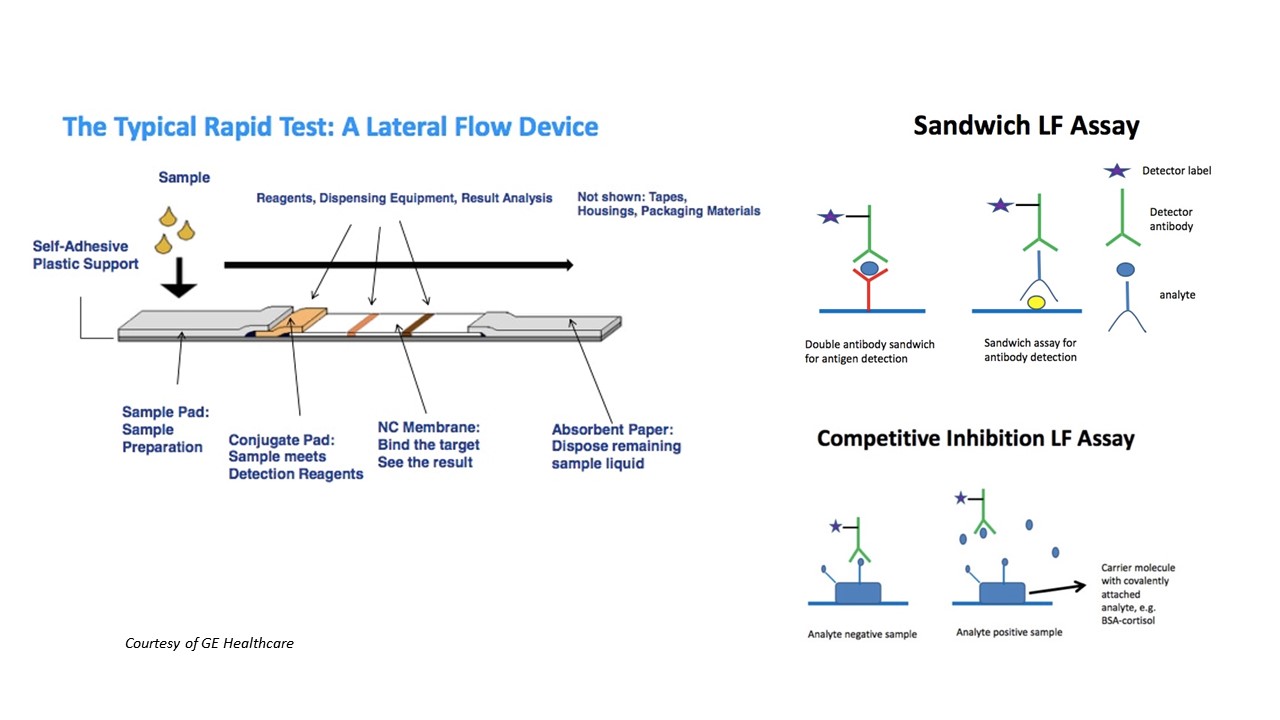
Sample Pad
Label Pad
Membrane
Test line
Control line
Absorbent pad
Backing card and housing
The working principle is based on capillary action, specific molecular recognition, and the accumulation of labeled particles.
A liquid sample is added to the sample pad. The sample moves through the sample and reaches the label pad by capillary action and dissolves the dried detection reagent.
The liquid carries the labeled reagents and any resulting complexes along the membrane. At the test line, immobilized capture antibodies recognize the target or another part of the complex.
If a non-competitive assay format is used, the labeled particles accumulate at the test line, producing a colored band. If a competitive assay format is used, the labeled particles will not
accumulate at the test line. In either format, unbound detector reagent will continue up the membrane and will be captured at the control line. The control line indicates that capillary flow along
the membrane proceeded as expected. It does not guarantee that the test has worked perfectly.
There are two major formats used for antigen or antibody detection: A non-competitive format (refered to as a Sandwich lateral flow assay) and a competitive format.
The non-competitive format is commonly used when the target is large enough to bind two recognition molecules simultaneously. A positive result produces a visible signal.
Examples: are Pregnancy tests and covid tests. Both have large target molecules
The competitive lateral flow assayformat is often used for small molecules that cannot bind two antibodies simultaneously because they have only one suitable recognition site.
The target in the sample competes with a target-like substance or immobilized target reagent for binding to the detection reagent.
Examples include drugs, drugs of abuse, steroids, and other small molecules.
An important difference between the 2 formats: In a non-competitive assay, a test line appears and gets stronger for a positive result, while in a competitive assay, a test line gets weaker or even disappears for a postivie result.
Please contact us to set-up a free initial project consultation